Before the Printed Form: How Public Notices Found Their Readers
Public notices moved from spoken announcements to posted paper in varied ways. See how place, repeat reading, and carried copies shaped who could hear.
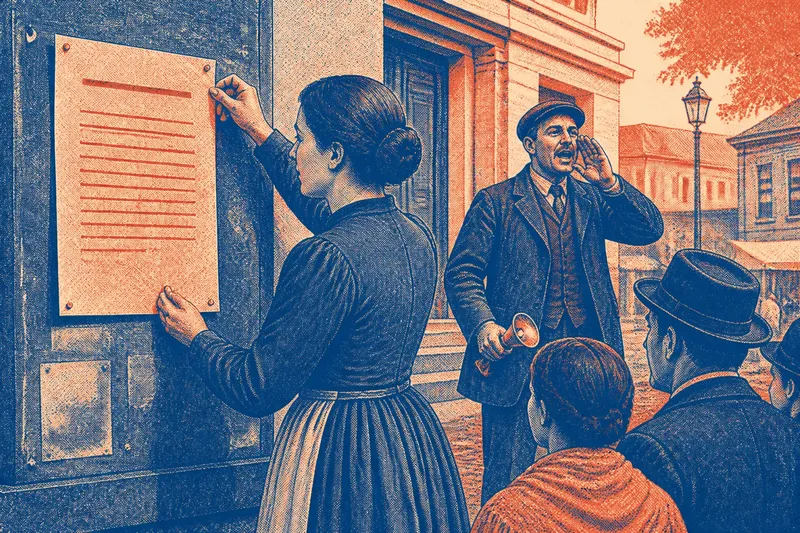
At a town hall, a clerk pins a meeting notice beside the entrance as someone calls the time to people nearby. The public notice reaches two audiences differently: listeners who are present and readers who may arrive later. In many settings, spoken announcements and posted writing worked alongside one another rather than in a simple sequence.
Voices in shared places
A spoken notice belongs to a moment and a gathering. A bell, a caller, or an official addressing a queue can make an instruction audible without requiring paper or the ability to read. The message then travels through listeners who remember it and pass it along in their own words.
That chain can spread useful information, but each retelling may omit a condition. Someone might remember that a building is closing without recalling which entrance is affected or when the change begins. The message persists in memory, not as wording everyone can inspect.
Place shaped the audience. A caller near a market, courthouse steps, or transit stop could reach people already gathered there, but not necessarily those who came later. Timing, crowd noise, and who was allowed or able to gather all affected who heard the announcement.
Paper that waits
A posted sheet changes when someone can encounter information. It can be read after its writer has left and revisited by people arriving at different times. A reader can pause over a date or ask another person to check a line. The notice gives the wording a temporary material presence, though it may be removed or overlooked.
Its location still determines much of its reach. A sheet beside a service counter is likely to meet people seeking help there; one near an entrance may catch the attention of passersby. Pinholes, paste marks, frames, and faded patches can show that a surface was used for notices. They do not, by themselves, tell us who saw a particular sheet.
Writing makes a detail available for another look, but it does not make the message complete or clear. A reader can compare a date, name, or condition with the printed line. Someone who cannot read the language, cannot reach the posting place, or arrives after removal may still depend on another person to relay it.
Printing and circulation
Printed copies could be prepared with matching wording and placed in more than one location. That possibility did not replace spoken announcements everywhere, nor did it give every community the same access to print. Its practical effect depended on local arrangements: who prepared the text, where copies went, and whether people could obtain or read them.
A handbill could also leave its original wall. Someone might carry it home, show it to a neighbor, or keep it beside a calendar. In those circumstances, the wording could be checked away from the place where the notice first appeared. A copied sheet could travel, although a copy might be incomplete or separated from later corrections.
Printing therefore changed the ways a notice could be repeated and revisited, not simply the amount of information available. The result varied by place and occasion. A printed notice still depended on distribution, suitable posting locations, readable wording, and upkeep.
What can a notice tell us?
How did people hear public notices before printing?
Officials, callers, or other speakers could address people gathered in a public place. Their message reached those present, while later listeners often depended on someone repeating it.
Why post a notice instead of announcing it aloud?
A posted notice could be read by someone who arrived after an announcement and checked again later. It offered a fixed version of the wording, though the sheet might be hard to find, read, or keep current.
Could printed notices travel beyond their posting place?
A handbill or copied sheet could be carried or shown to someone who had not visited the original site. The copy might preserve the wording, but it might not include a later correction or explain the original context.
What physical traces suggest a place displayed notices?
Pinholes, paste marks, a notice frame, or a faded patch can suggest that paper was attached to a surface. These traces indicate a past use of the space, not the date, contents, or audience of a particular notice.
Reading physical traces
A large heading can be seen from farther away than dense lines of text, which usually invite a closer look. Several sheets with the same title may have come from one source, but their presence alone cannot establish how widely they circulated. A handwritten correction suggests an attempt to update a copy; it can also leave readers unsure which wording is current.
Say you find an invented notice on a library door announcing that a meeting has moved to another room. It names a date and an issuing office, while a second invented handbill inside gives a different room. You compare the dates and wording, then contact the named office; the observable result is that you have identified a conflict and know which source can clarify it, rather than treating either sheet as definitive.
For a present-day public notice, the same practical question applies: can a reader return to the information and identify its source? A plain heading, a visible date, and a recognizable issuing office help make the wording easier to check. Copies placed in several locations can reach different readers, but they also need attention when details change.
Keep the setting in view
A public notice is more than words on a sheet. Its meaning depends on where it was posted, who could reach it, how long it remained, and whether another version circulated. When you encounter an old notice or the marks of one, distinguish what the physical evidence shows from what it cannot establish. That distinction keeps the history of public notices grounded in the places and people that gave each message its reach.